
Read the balance sheet of Celtic PLC and you will find a story of quiet triumph. It’s an outlier in what is frankly a bizarre industry. Revenue rising from £52 million in 2016 to £143.6 million in 2025. Profit after tax of £33.93 million in the most recent financial year. A return to profitability after the COVID-ravaged £12.6 million loss of 2021. Cash reserves approaching £80 million . By any conventional measure of corporate health, this is a business firing on all cylinders.
But financial statements measure only what has been counted, not what has been lost. They capture revenue but not ambition. They record profit but not progress. And for Celtic PLC, the gap between corporate performance and footballing achievement has rarely been wider.
The numbers tell us that Celtic are among the best-run football businesses in Europe outside the elite leagues. The same numbers, examined through the lens of the club’s self-declared peer group, tell us that being well-run is no longer sufficient. In the modern game, being well-run means being structurally evolved—and here, the evidence suggests Celtic have been standing still while others have sprinted past.
In a previous article, I analysed and compared 3 reference clubs in Bodo/Glimt, Midtjylland, Club Brugge in focus on financial and cultural structure. The table below gives a view of Celtic’s published accounts over the past decade and verified against the club’s official 2025 annual report .
Celtic PLC Financial Summary 2016-2025 (GBP million)
| Year | Revenue | EBIT | Net Profit | European Performance |
| 2025 | 143.60 | 45.69 | 33.93 | Champions League Knockout Phase Play-Off (eliminated by Bayern Munich 3-2 on aggregate) |
| 2024 | 124.58 | 17.83 | 13.38 | Champions League Group Stage |
| 2023 | 119.85 | 40.70 | 33.33 | Champions League Group Stage |
| 2022 | 88.24 | 6.14 | 5.85 | Europa League Last 16 |
| 2021 | 60.78 | -11.49 | -12.60 | Europa League Group |
| 2020 | 70.23 | 0.10 | -0.37 | Europa League Group |
| 2019 | 83.41 | 11.31 | 8.74 | Europa League Group |
| 2018 | 101.57 | 17.27 | 15.42 | Champions League Group |
| 2017 | 90.64 | 6.90 | 6.90 | Champions League Group |
| 2016 | 52.01 | 0.46 | 0.46 | Europa League Group |
Source: Celtic PLC Annual Reports
The trajectory appears encouraging. Revenue has nearly trebled in a decade. EBIT (earnings before interest and tax)—a key measure of operating profitability—peaked at £45.69 million in 2025. The COVID-induced loss of 2021 has been more than recovered. Bear in mind also it was the support base who stepped in here, paying for tickets for games that would never take place.
These numbers require contextualisation. The 2025 figure of £143.6 million reflects a memorable European campaign under the new Champions League format. We played eight group stage matches, earned 12 points and finished 21st out of 36—sufficient to qualify for the knockout phase play-offs, where we faced Bayern Munich. The tie was lost by a single goal following an aggregate 3-2 defeat, with Celtic leading on the night in Bavaria before Alphonso Davies equalised in the 94th minute . Chairman Peter Lawwell described it as “a source of pride for the Club and our supporters”. Jam today, plucky underdogging and hurrah.
The Midtjylland Comparison
Now consider FC Midtjylland, a club who horsed us 3-1 in the Europa League in November. Midtjylland’s revenue in 2023-24 reached approximately €60 million—less than half of ours. Their wage bill is one-third of Celtic’s. Their stadium capacity is 11,800, compared to Celtic Park’s 60,000.
Yet Midtjylland’s transfer spend rose from €3 million in 2016-17 to €36 million in 2023-24. They have achieved this not through greater revenue, but through superior capital allocation. Every pound earned is deployed with analytical precision. Every player sale is timed for maximum value, with reinvestment locked into the recruitment machine rather than distributed as dividend or retained as cash.
The contrast with Celtic’s player trading model is stark. In 2025, Celtic recorded a gain on sale of player registrations of £31.5 million—up dramatically from £6.6 million the previous year . The departures of Kieran Tierney, Odsonne Édouard, Jota and Matt O’Riley alone exceed £100 million in aggregate income over recent seasons. But the pattern of reinvestment has been inconsistent. In 2025, the club invested £38.6 million in player acquisitions, more than doubling the prior year spend and marking the highest single-season investment in the club’s history, including twice breaking the Club transfer record. Lawwell noted that over the three years to 30 June 2025, total investment in player registrations including committed agent fees has totalled £77.5 million. To paraphrase Limmy though, “at what cost…?”
Sales have been followed by bargain-bin replacements or stopgap loans, eroding the squad value that made the sales possible in the first place. This season we’ve reached peak managed squad decline.
The Club Brugge Discipline
Club Brugge offer another illuminating benchmark. In January 2026, the Belgian champions rejected cumulative transfer offers exceeding €100 million for three players—Raphaël Onyedika, Joel Ordóñez and Christos Tzolis. CEO Bob Madou explained the rationale with devastating simplicity: “It’s simple: if we keep our best players, our chances of winning the league are greater. And that brings income—via the Champions League and added value on transfers.” Fucking Glaswegian heresy.
Celtic’s accounts show no equivalent discipline. The club’s best players remain perpetually available at the right price. The squad is annually weakened by departures that are financially prudent but competitively damaging. The result is a constant cycle of rebuilding, with European progress forever postponed until “next season.” Yet our ability to be a club that develops Champions League talent and sells that on for profit looks more and more like a soundbite. See Engels, Arne and Maeda, Daizen for reference. We have literally fcuked millions down the bath as we had no plan, no strategy and we’re winging it.
The Cash Position
Perhaps the most telling figure in Celtic’s accounts is the one that does the least work: cash reserves of £77.3 million at year-end 2025, broadly flat against the previous year’s £77.2 million. In any normal business, such liquidity would signal preparation for major investment. In football, it signals either prudence or paralysis—and the distinction matters.
The Celtic Star’s August 2025 analysis posed the question directly: “Even a modest 10-15% of the club’s reserves—an estimated £10–15 million—could radically transform Celtic’s internal football structure. It’s not just about recruitment. It’s about the machinery that drives long-term success.”
That machinery—analytics departments, global scouting networks, elite sports science infrastructure—is precisely what Midtjylland and Bodo/Glimt have built with far fewer resources. Celtic have the financial capacity to build it ten times over. We have simply chosen not to.
GOVERNANCE & FAN ENGAGEMENT—PERMAFRACTURED
If the financial analysis reveals a gap between resources and results, the governance analysis reveals why that gap persists.
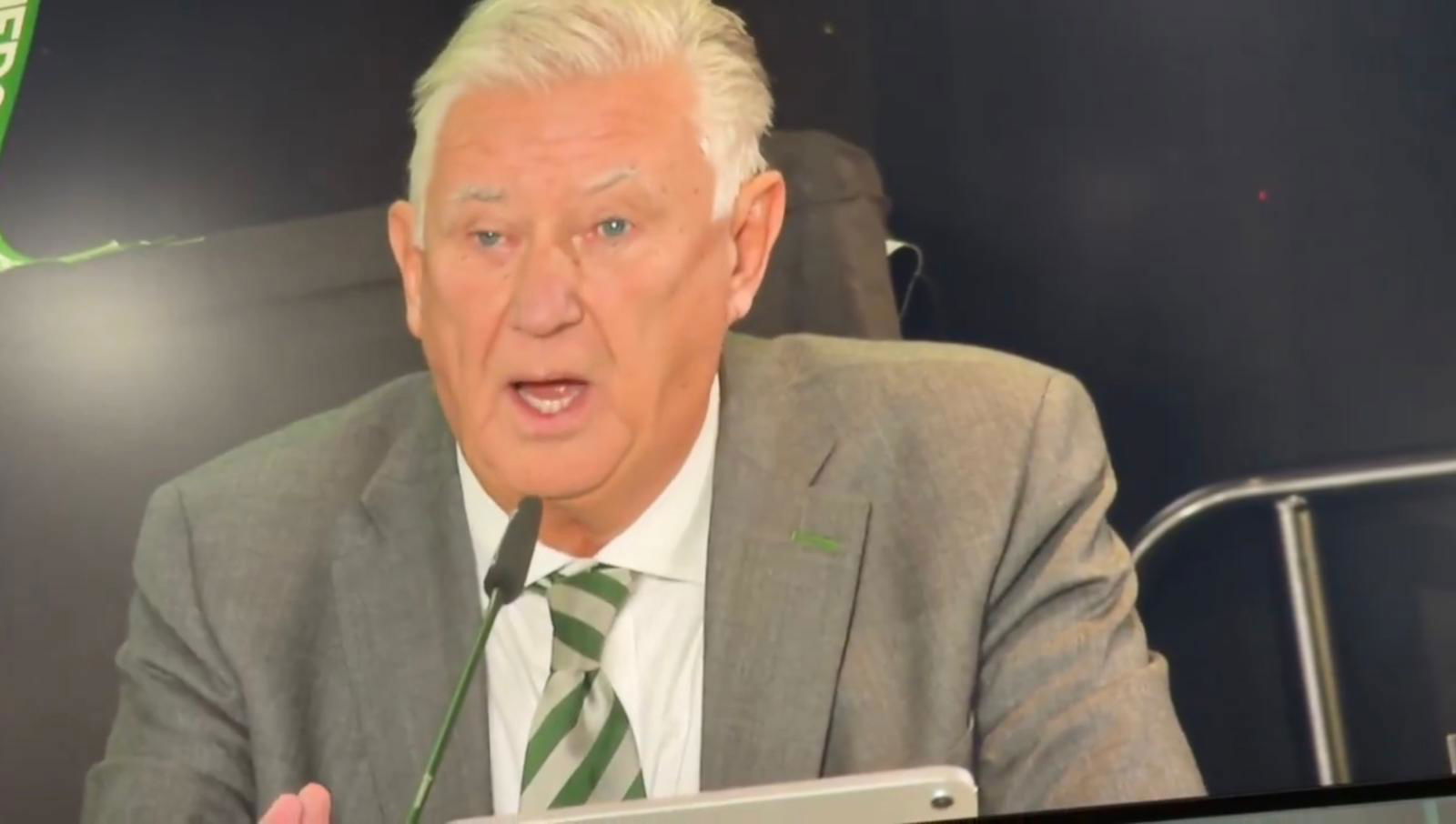
The November 2025 Annual General Meeting offered a public window into a private dysfunction. A meeting cut short as fans protested against the board. Chairman Peter Lawwell condescendingly halting proceedings following the reaction to a speech from Ross Desmond. The club subsequently blamed “organised disorder” from the Celtic Trust and the Green Brigade for the disruption. Sit down, behave, be grateful your overlords are here.
The aftermath was more revealing than the meeting itself. The Celtic Fans Collective—representing multiple supporter groups—issued ten formal questions to the board. They included:
- “Can the board please explain the ownership and governance structure of the PLC, specifically clarifying whether Dermot Desmond exercises effective control through holding 50.1% or more of the shares?”
- “In line with the QCA Code, can the board comprehensively outline the review process undertaken to ensure that all board members remain genuinely independent and representative of all shareholders?”
- “Can the board outline the PLC’s investment policy for the first-team squad and walk shareholders through the process by which player acquisitions are undertaken using shareholder funds?”
- “Can the board confirm whether this policy is benchmarked against comparable or smaller clubs operating successfully within similar financial parameters, such as FC Midtjylland or Club Brugge?”
The questions were never answered. The AGM poll results saw every board member re-elected with majorities exceeding 99%. Two resolutions from the Celtic Trust—calling for a five-year strategic review and a vote of no confidence in the board—were defeated.
This is the governance paradox of Celtic PLC. A structure that delivers financial stability also insulates the board from accountability. With a controlling shareholder bloc of approximately 34%—sufficient to defeat any resolution—shareholder democracy becomes ceremonial rather than substantive. Never did the Kelly’s and Whites have such a fine moustache among them.
The Academic Evidence
The University of Glasgow conducted the largest independent survey of Celtic stakeholders in recent times, polling 7,791 respondents across supporters, season ticket holders, shareholders and fan organisation members.
The findings were damning:
- The quality of fan engagement was rated “average” by the largest response category
- Only 36% of shareholders rated engagement as “Very Good” or “Good”
- 67% of shareholders supported the creation of an independent Fan Advisory Board
- 76% of fan organisation members supported the same
The survey concluded that Celtic “face major fan/stakeholder engagement issues and may benefit from an elected fan advisory board (FAB) in line with UK fan led review of football governance.”
The New Challengers
Whatever your view of how things emerge, timing and all, September 2025 saw the emergence of Celtic Supporters Limited (CSL), a new fan organisation with a distinctively professional approach. Headed by Duncan Smillie (former Partick Thistle chairman), David Low (key figure in Fergus McCann’s 1990s takeover) and Peter McGowan, CSL describes itself as “a vehicle for shareholders, season ticket holders and supporters of Celtic Football Club to unite around and to articulate a collective view to the Board.”
Crucially, CSL is structured as a company limited by guarantee, with directors elected by members on a one-member-one-vote basis. Its stated mission is to tackle the problem of “untraced shares”—an estimated 20% of Celtic’s 28,000 shareholders—and to acquire proxy votes that can challenge the board’s near-total control of AGM outcomes.
Smillie articulated the frustration driving this initiative: “It is a broken relationship yet, ironically, all sides want the same thing. The board, the fans, and shareholders all want the best for the club. How to get there is the issue.”
The Right Honourable Lord Haughey – for it is he – has also recently announced an initiative to get into position as the race commences.
Haughey has pledged to invest over £10million in Celtic shares – if backed by the club’s supporters. His plan to launch ‘The Celtic Season Ticket Alliance’ in a bid to give fans a voice in boardroom matters seems to be somewhere between the Celtic Trust vehicle and CSL.
“I’m going to look at setting something up. I believe that the 54,000 season ticket holders are the core. They are the heartbeat of Celtic”
Willie – or Lord Haughey depending on the social context and whether you’re a billionaire absent landlord looking for access to the political class- has at least identified the one core constituency that can effect change from literally within the stadium, that being the book holders. In the absence of detail, out of all the initiatives it looks probably the most grounded in reality in terms of affecting change and having visibility and focus. But it’s equally as flawed.
And what the fcuk is it with Celtic Football Club and British Lords?
If the game isn’t 100% Fan Ownership it’s just another game of Celtic musical chairs. At the time of writing, rumours of Lord Haughey investing in moustache serum as we type are as yet unconfirmed.
FAN OWNERSHIP—COULD YE, WOULD YE, WILL YE?
The emergence of CSL, alongside the existing Celtic Trust and the broader Celtic Fans Collective, raises an inevitable question: could Celtic ever become fan-owned?
The answer requires examining the models available and the structural obstacles in place.
The German 50+1 Model
Germany’s Bundesliga operates under the “50+1” rule, which requires clubs to hold a majority of their own voting rights—effectively giving members (fans) control over strategic decisions. The rule has produced the healthiest fan culture in European football: average attendances exceeding 39,000, reasonably priced tickets, and genuine supporter influence over club direction.
David Winnie, Partner and Head of Sport at Gilson Gray, explains the philosophy: “The success of the German 50+1 model enshrines in law that clubs belong to their communities more than they do any individual, corporate vehicle or state.”
The contrast with the UK model could not be starker. English football’s Public Limited Company (PLC) structure, as analysed in the recent academic work “Contradictions in Fan Culture and Club Ownership in Contemporary English Football,” has transformed clubs from community institutions into global businesses. The authors document the “economic and cultural asset stripping” that occurs when fan interests are subordinated to shareholder value.
The Hybrid Model
Complete fan ownership of Celtic is structurally improbable in the short term. Dermot Desmond’s stake—estimated between 30-40%—would require acquisition at market value, implying a cost of approximately £50-70 million based on the club’s market capitalisation. The Celtic Trust and CSL, combined, control nowhere near these resources.
But hybrid models offer a more plausible pathway. As the Business Council for Co-operatives and Mutuals notes, fan co-operatives can sit alongside private owners through joint venture structures. Models overseas range from a 5% stake to full community ownership. The UK now has more than 140 recognised supporters’ trusts holding ownership stakes in football clubs.
The key principle is that fan ownership need not be binary. A minority stake, combined with enhanced governance rights—such as board representation or veto power over certain decisions—could transform the relationship without requiring a full buyout.
The McCann Precedent
Celtic have done this before. Fergus McCann’s 1994 takeover was built on a share issue that mobilised the support base and created a dispersed shareholder structure. The subsequent decade saw the most successful period in the club’s modern history, on and off the pitch.
The lesson is not that fan ownership is inevitable, but that structural change is possible when the existing model fails. McCann acted because Celtic were dying. The current club is not dying—but it is stagnating, and stagnation in football is a slow death.
WHERE THE FCUK ARE WE GOING – BASED ON FIVE YEARS OF EUROPEAN EVIDENCE
The final question is the hardest: where will Celtic stand in European football five years from now?
The evidence of the past five years offers a mixed picture. Consider the record:
2021-22: Europa League Last 16 (eliminated by Bodo/Glimt)
2022-23: Champions League Group Stage (4 points)
2023-24: Champions League Group Stage (4 points)
2024-25: Champions League Knockout Phase Play-Off (eliminated by Bayern Munich 3-2 on aggregate)
2025-26: Europa League Last 24 (eliminated by VfB Stuttgart)
The pattern is one of consolidation at a level below the club’s historical aspirations but above the mid-2010s doldrums. The 2024-25 campaign was genuinely encouraging: 12 points from eight group stage matches, qualification for the knockout phase, and a creditable aggregate defeat to Bayern Munich that saw Celtic lead on the night in Germany . Chris Sutton described reaching the knockout rounds as a “massive achievement,” noting the club hadn’t managed it for over a decade .
Yet the warning signs are flashing. In February 2026, the BBC reported that Scotland is set to lose its second Champions League place from 2026-27 onwards . The Scottish Premiership has dropped from 14th to 18th in the UEFA coefficient rankings. Only the top 15 nations get two Champions League spots .
Self styled football finance expert Kieran Maguire spelled out the consequences: “Celtic made more than £40m from the Champions League in 2024-25. For every one pound you earn in the Champions League, you get approximately 22p in the Europa League and 11p in the Conference League. It is a sizeable difference” .
From 2026-27, the Scottish champions will enter the Champions League in the second qualifying round, meaning they must win three ties to reach the league phase, with no automatic Europa League safety net . The runners-up will enter the Conference League second qualifying round—a dramatic demotion from the Champions League play-offs they currently enjoy.
The Diverging Paths
The reference clubs illuminate the possible futures. Bodo/Glimt, from a town of 50,000, reached the Europa League semi-finals in 2025 and the Champions League group stage in 2025-26. Midtjylland, a corporate merger from 1999, sit atop the Europa League table. Club Brugge reject nine-figure transfer offers to keep their core together.
These clubs have chosen the path of competitive ambition over financial optimisation. They have accepted that short-term profit may be sacrificed for long-term progress. They have built structures—analytics, pathways, retention strategies—that Celtic lack.
The leadership of Celtic have chosen a different path. The accounts prove it. The cash reserves prove it. The AGM dynamics prove it.
The Prediction
So, grim reading as it is, and with a heavy dose of cynicism here’s one vision of the future.
If the current governance and strategic framework persists—if the board continues to enjoy 99% shareholder support, if the cash mountain remains unmined, if the player trading cycle continues unchecked—Celtic’s European status will face serious headwinds. The loss of the second Champions League place will compound the financial disadvantage relative to clubs from stronger leagues . The coefficient gap to the Netherlands, Belgium and Portugal will widen. Direct qualification for the Champions League group stage will become harder, not easier.
The 2024-25 campaign demonstrated what is possible when the existing model functions effectively. Twelve points, a credible performance against Bayern Munich, and the highest single-season investment in playing squad in the club’s history . The resources exist. The support exists. The question is whether the structural evolution can keep pace with the changing landscape. If we’re really honest, 24-25 was peak Brendan. It genuinely was the pinnacle of what we as a club can achieve in the straightjacket we self-inflict.
If the fan organisations succeed in shifting the governance dynamic—if CSL’s proxy campaign gains traction, if a Fan Advisory Board is established, if the board is compelled to benchmark against Midtjylland and Brugge—then the resources exist for a rapid transformation. The £77 million cash reserve could fund a decade of structural investment. The global supporter base could be mobilised behind a shared vision. The McCann precedent could be revived.
The choice, as it always has been, belongs to those who hold the shares—and to those who hold the club in their hearts.
THE LEDGER, THE FUTURE AND THE LEGACY
Celtic PLC is a financial success. The numbers prove it. Revenue grows. Profit returns. Cash accumulates. By the standards of the London Stock Exchange’s AIM market, this is a model company.
But football clubs are not model companies. They are not judged by EBITDA margins or earnings per share. They are judged by nights in Lisbon, by victories over Barcelona, by the roar of 60,000 voices believing that something extraordinary might happen.
The ledger shows profit. The legacy shows a club capable of competing—the 2024-25 campaign proved that—but structurally constrained from sustaining it. And the gap between what is possible and what is achieved is the measure of what has been lost.
The fan organisations asking questions at the AGM are not troublemakers. They are the conscience of a club that has forgotten what it could become. The academics surveying the support are not agitators. They are documenters of a relationship that has frayed to breaking point.
And the reference clubs—Bodo/Glimt, Midtjylland, Club Brugge—are not competitors. They are mirrors. They show what is possible with less. They ask the only question that matters:
Imagine what is possible with more. With our resources. Why the fcuk do we not have ambition?
Celtic have the resources. We have the support. We have a storied history. The 24-25 Champions League campaign showed we have the capacity to compete at a level many thought beyond. Bodo/Glimt are in the last 16 of the Champions League. Why aren’t we even thinking of that as a reference point?
Ultimately, we lack the structural evolution to make that the baseline rather than the exception.
I said it in the previous article, Celtic can’t get there – absolutely cannot – with the existing executive team led by an overpaid lawyer and accountant. They are simply out of their depth.
Until that changes, the ledger will keep growing—and the gap between profit (masked as prudence) and progress will keep widening. Every now and again we’ll have a shit season and dip into the cash. And we’ll be told that’s why the cash was hoarded and weren’t the custodians great etc etc. And the wheel will keep turning.
We truly are at the crossroads.
Excellent analysis good on detail. I was confused by your point about Brugee keeping their best players while you advocated selling g Engels snd Zmaeda. Neither Maeda or Hatate seem to have responded well to not being sold, how do Brugee deal with that variable??
Thanks for the feedback BJF. I think what Brugge do is plan for the eventuality. We seem to hope rather than expect.
For Engles, the most glaringly obvious one was Lennon Miller. Sign him up start of last season, leave him at Motherwell to develop, then bring him in start of this season to compete. We get an offer for Engels, sell at peak, repeat the process with Watson at Killie. 2+ years of Miller and sell on, Watson steps up. It’s not a hard cycle to inject wealth into the Scottish game while ensuring we get the best Scottish talent.
Maeda is unique in that he is just missing a tiny bit of quality that would make him an EPL starting level winger on 200K a week. But similar in process. Brugge signed a 19 year old winger Forbs at the start of the season for 6M from Ajax having sold Talbi, another winger to Sunderland for 20M. Forbs straight into team. Excels in Champions league. Will go in 1-2 years for 20M+ and they’ll repeat the process.
I believe there is absolutely no reason why Forbs would not have come to us over Brugge had we done a deal with Ajax. We lack people with the ability to think strategically like that and execute deals.
We speculate that Maeda & Hatata ‘s form has slipped because they weren’t allowed to leave . That may or may not be true . Both players could have family illnesses or suffering from a nagging injury which is holding them back from playing at their best
Great Imforation
That really is one fantastic article and it has proven beyond doubt to me that my depression at the current state of Celtic FC is well-founded.
I hope this response is given the courtesy of being aired, unlike my last effort on an earlier thread.
I’ve been sounding off for years about the negative effect of Lawwell, even from fairly early on. A bean-counter who could only follow Dermott, ‘his master’s voice’, and then gradually, bit by bit gained in confidence (and confidence trickery) to become the super ego that ran the Celtic plc show with the club heading downhill except for the odd hiccough. It’s an absolute disgrace that he’s walked away without punishment. So far. Those he’s appointed are so far out of their depth they’re sinking without trace but not without calamity at OUR FC.
There’s still hope but we need UNIFICATION and supporter ownership. Why didn’t Haughey speak to the new Celtic Fans Collective and CSL? It kinda stinks that and I scent Desmond but haven’t figured out what they’re REALLY up to. We need to rapidly re-group and win the Title, the SC, to me, no longer matters if we don’t win the league. Brilliant article you’ve written though, truly brilliant.
Guys like you (and quite a few others) give me some faith, not the religious kind the Celtic FC kind!
Thanks for that!
Great article again and, sadly, I remain pessimistic about change when those with most to lose are in charge.
Our revenue essentially comes from the fans, directly through matchday income, merchandising etc and indirectly through the likes of corporate hospitality, which is purchased for the benefit of Celtic supporting employees and customers.
This is the basis on which to, normally, overwhelm domestic competition leading to increased revenue in prize money, European participation etc.
All of this is despite and not because of the Executives, whose only Value Add would be in negotiating higher value in commercial contracts etc.
Is there any evidence that they’ve added a single pound in value to a contract ie we get top dollar because we’re top dog and not through any input from the Executive.
The Player Trading Model is a complete misnomer for me. We’ve signed something like 89 players in the past 10 years or so, the vast majority of whom have been absolute failures. If the whole cost of this debacle was added together (transfer fees, wages, coaching/medical etc costs, blockages for youth players etc) then we’d have a significant loss and not a profit.
I defy anyone to come up with a single example of another club, considered a success, that has such excretable wastage.
We are the rich guy who buys 100 scratchcards and celebrates the odd win but overall, out of pocket.
The Celtic Fan Collective isn’t one, small body of Celtic fans, it is the umbrella grouping of all the major fan organisations, representing tens of thousands of fans.
One of these, is the Celtic Trust, which has been representing fan shareholders for 30 years.
The only reason to setup a rival organisation, CSL, is to act as a disruptor and not of the board but of fan unity.
Add to that, the expected but still depressing intervention of Lord Haugh haw. It’s another “me, me, me” initiative masquerading as a fans united when the fans have united under the Collective like never before.
He’s an ex-NED and at no stage did he ever call out the board, he’s part of their collective and the only thing he’s independent of is the united Celtic fanbase.
He recently resigned from Queens Park, as the mild criticism he got there, was too much for him. Is that really the calibre of person we need?
I’ve seen this enough in politics and elsewhere, when there’s a ferment of revolt that individual egos attempt to insert themselves into the debate. Not to align with the fans but knowing, if the board give an inch, they’d prefer to do for those looking for a comfy seat and not a united fanbase.
There will be no common sense prevailing if Celtic Collective have any role . Imagine the only achievement they have had so far was pissing off our elite manager who always appreciated the help from Celtic fans , but when MO’N claims they need their heads examined , it shows how out of touch from reality some fans are
The Collective represents the vast majority of Celtic fans and organisations.
They’ve published intelligent demands regarding strategic direction, recruitment processes, both on and off the field and ambitions for European competitiveness etc.
These well-reasoned questions would be simple to answer for a competent board and executive.
They’ve been unable to answer a single point and there’s the rub.
So far, their actions have got rid of Lawwell completely humiliated Nicholson, so it’s only a matter of time before he also goes.
They’ve also forced the board to the negotiating table and although progress is painfully slow, this is understood and is why pressure needs to be maintained.
Martin O’Neill has always spoken warmly and enthusiastically about the Celtic fans and no amount of contrarianism from the (very) odd board fan will sully that special relationship.
Good comment, Cha, pretty much as expected from you.
Hope all’s good where you are, still in ‘The Smoke’?
Also hope today’s game didn’t take too much out of you, 1st half especially of course.
Martin continues to keep us ‘in the hunt’ but he’s working with one arm tied behind his back due to the board’s repeated failings, window after window. Incredibly though, some folk think Lawwell and Co did more than alright. Well, they’re HALF right: they did alright for themselves whilst cheapening and weakening Celtic FC. I just hope they all pay for it in spades and spend the rest of their lives doing so.
Lawwell’s gone and hopefully for good, clearly for the good of Celtic FC, but the dross he appointed during his tenure has to go too. Oh and ONE shareholder!
On the same subject:
Custodian or Captor? How Dermot Desmond Keeps Celtic in Limbo
The Title is Over, the Rebels Must Fight On!
The asset stripping of Celtic’s 1st team primary assets prior to ECL campaigns/key matches, e.g. Jota, O’Riley, Kyogo, Kuhn & Idah 2023-25 and B team top prospects Dembele, Vata, Kelly, Cummings & Anderson 2022-25 freed out of contract with no transfer/sell-on fees or buy-back clauses should be actionable under Companies Act 2006 Part 11 Derivative claims.
An excellent and well reasoned article.We can only hope that common sense prevails and the board remove the tin ears.i remain sceptical.